 Tech ID
Introduction
The DJI CINESSD by SZ DJI TECHNOLOGY CO., LTD. stands as a cornerstone of professional aerial cinematography, designed to meet the high-speed storage demands of the DJI Inspire 2 and compatible equipment. As filmmakers and content creators push the boundaries of high-resolution, lossless video capture, reliable and robust storage solutions are essential. The DJI CINESSD delivers on this promise, enabling seamless recording of high-bitrate footage critical for post-production workflows.
With its FCC certification (FCC ID: SS3-PS522M21611), the DJI CINESSD meets stringent US regulatory standards for electromagnetic compatibility and RF emissions, ensuring it is legal for sale and use within the United States. While the grant date is listed as “None,” its presence in the FCC database confirms compliance and market readiness. This article offers an authoritative exploration into the DJI CINESSD’s key features, technical specifications, wireless technologies, internal hardware, and regulatory background, providing a comprehensive resource for engineers, tech enthusiasts, and professional users seeking to understand the technology behind this high-performance storage device.
Read on for an expert breakdown of the DJI CINESSD’s design, internal components, and the significance of its FCC certification.
Key Features & Specifications
The DJI CINESSD is engineered to deliver uncompromising performance and reliability, making it an indispensable tool for professional video production. Here’s a detailed look at its core features and technical specifications:
Key Features
- Essential for Lossless Video Recording: Enables direct capture of uncompressed, high-bitrate footage, vital for post-production flexibility and image fidelity.
- High Performance Storage: Purpose-built for sustained data rates required by 4K/5K video, minimizing dropped frames and data loss during demanding shoots.
- Designed for DJI Inspire 2 & Other Equipment: Seamless integration with DJI’s flagship drone and compatible hardware, ensuring plug-and-play operation and optimal system performance.
- Robust Build for Professional Use: Engineered to withstand the rigors of fieldwork, including wide temperature and humidity ranges.
Technical Specifications
- Weight: 42.5 g
- Capacity Options: 120GB / 480GB
- Dimensions: 105.6 mm × 27 mm × 7 mm
- Operating Temperature: 0°C to 40°C
- Storage Temperature: -40°C to 85°C
- Humidity Range: 5% to 95%, non-condensing
- Bluetooth Capability: Present (details not available; may support device pairing or configuration)
Practical Benefits
- Professional-Grade Reliability: The wide operating and storage temperature ranges, combined with high humidity tolerance, ensure stable performance in diverse environments—crucial for aerial and outdoor shoots.
- Speed & Efficiency: Large NAND flash capacity and advanced SSD controller enable rapid data transfer, supporting prolonged shooting sessions without interruption.
- Thermal & EMI Management: Advanced enclosure and internal thermal pads maintain optimal operating temperatures and protect against electromagnetic interference, vital for high-speed digital circuits.
In summary, the DJI CINESSD is tailored for professionals demanding consistent, high-speed, and reliable storage—attributes that are non-negotiable in high-resolution video production environments.
Operating Frequencies
This device operates on the following frequencies as detailed in its FCC filing:
No detailed frequency data could be parsed or is available for this device.
The specific bands and power levels are crucial for understanding the device’s wireless capabilities, range, and adherence to regulatory standards for various technologies it might employ (e.g., Wi-Fi, Bluetooth, other RF communications).
Technology Deep Dive
The DJI CINESSD is fundamentally a high-performance SSD module, engineered for rapid data storage and retrieval. While the device is primarily a storage unit, the presence of Bluetooth (as indicated in the specifications) suggests potential auxiliary wireless functions—possibly for device pairing, status monitoring, or configuration. However, detailed information on Bluetooth implementation or supported profiles is not available.
Given the lack of detailed frequency data and the absence of explicit Wi-Fi or cellular modules, the wireless technology focus is minimal. Any wireless features (such as Bluetooth) would typically operate at low power, with limited range, intended for local device management rather than data transfer. This design minimizes interference with the core SSD functions and ensures low power consumption—critical for maintaining the integrity and reliability of high-speed storage operations in demanding environments.
From a performance perspective, the internal architecture—featuring high-density NAND flash, advanced SSD controllers, and robust power management—enables sustained throughput essential for lossless video capture. The careful engineering of PCB layout, grounding, and shielding further mitigates the risk of electromagnetic interference, ensuring compliance with FCC standards as validated by FCC ID SS3-PS522M21611.
In-Depth Internal Component Analysis / Teardown
PCB Back Side and Metal Enclosure
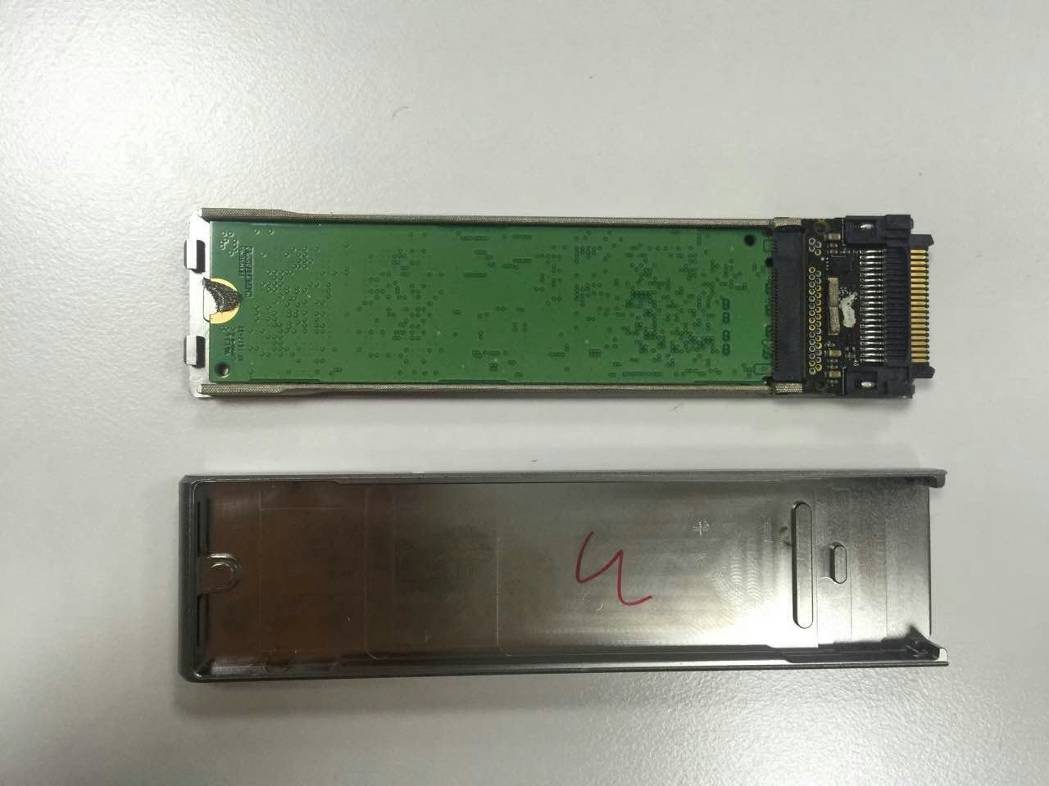
The back side of the DJI CINESSD’s PCB reveals a sophisticated, multi-layer design optimized for high-speed data transfer. This surface is largely free of major integrated circuits, instead populated with test points, vias, and minimal passive components. The density and arrangement of vias point to a robust ground plane strategy, crucial for signal integrity and EMI suppression. A gold-plated, high-density edge connector is visible, engineered for reliable, high-bandwidth interfacing with DJI’s host devices. The accompanying metal enclosure serves dual roles: providing EMI/RFI shielding and assisting with heat dissipation. The absence of significant components on this side is typical of double-sided PCB assembly in advanced SSDs, with critical ICs located on the opposite face. The overall construction reflects meticulous attention to durability and performance, befitting the device’s role in professional aerial videography.
Main Component Side with Thermal Management
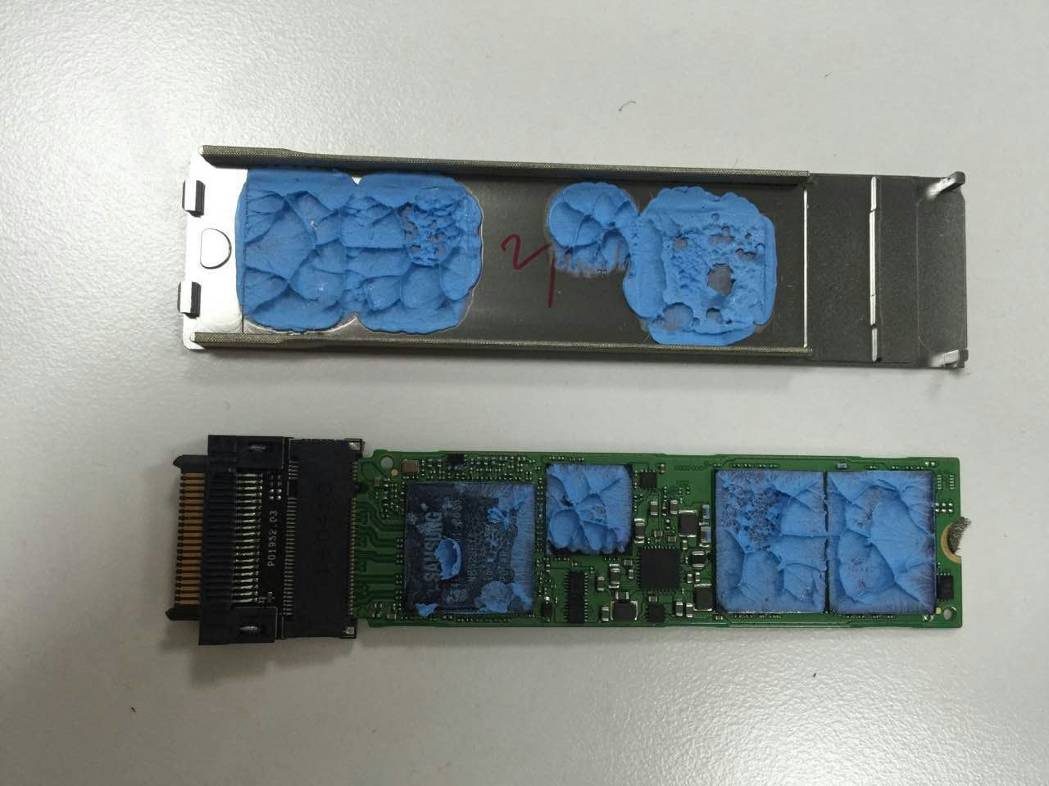
On the primary component side, the DJI CINESSD showcases its engineering prowess with a densely populated PCB. Multiple large NAND flash ICs—likely Samsung—are arranged alongside a central SSD controller, all partially covered by blue thermal pads for efficient heat transfer to the metal enclosure. This setup ensures stable operation under sustained high-speed data loads. Supporting the main chips are smaller ICs, probably DRAM cache for buffering and power management units, as well as an array of inductors and capacitors for clean power delivery. Differential pair routing and via-in-pad structures highlight the board’s readiness for high-frequency PCIe/NVMe signaling. The integration of thermal pads and a metal enclosure underlines the focus on both EMI shielding and thermal stability, which are critical for lossless 4K/5K video capture. Overall, this side of the PCB exemplifies a high-density, high-reliability SSD design tailored for professional use.
SSD Controller, NAND, and DRAM Cache Close-Up
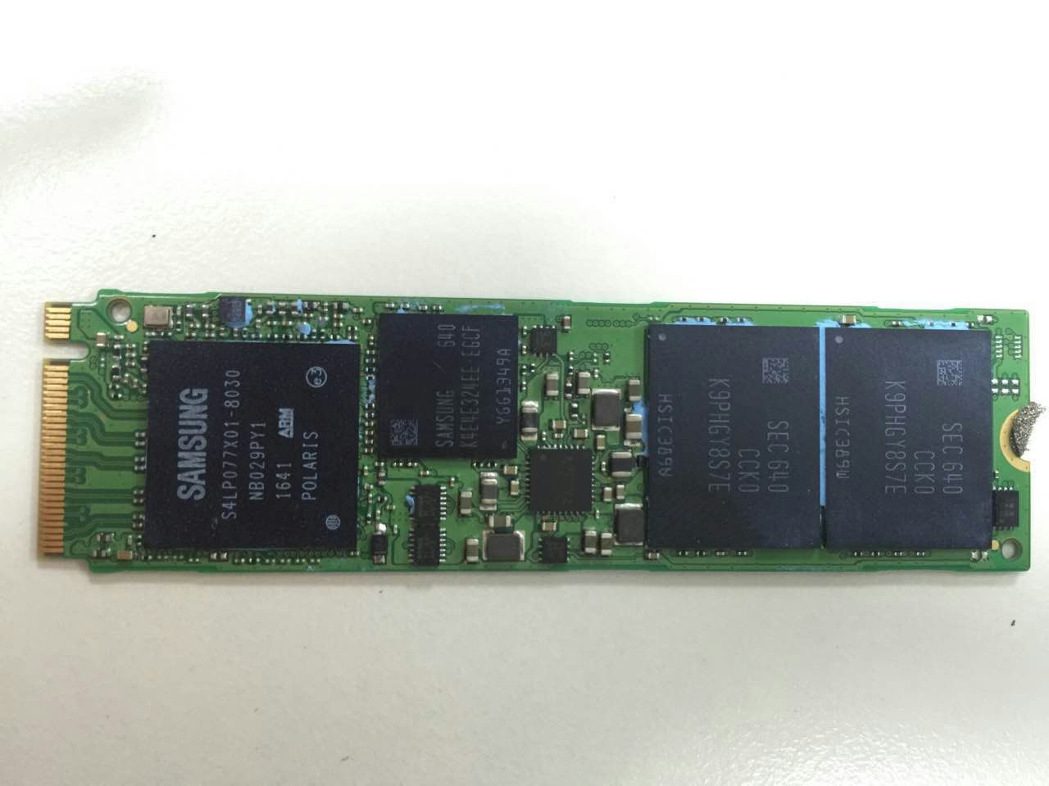
A detailed view of the PCB reveals the heart of the DJI CINESSD’s storage architecture. Dominating the board is a Samsung Polaris-series SSD controller, responsible for orchestrating NAND flash operations, error correction, and high-speed PCIe/NVMe communication. Flanking the controller are two substantial Samsung NAND flash chips, providing the device’s core storage capacity. An LPDDR3 DRAM chip sits nearby, serving as a cache to buffer high-bandwidth data streams and manage mapping tables for efficient flash utilization. The PCB layout is compact, with evidence of differential pair routing for PCIe lanes and robust power filtering via MLCC capacitors and small inductors. The presence of a crystal oscillator ensures precise timing for the controller. This configuration underscores the DJI CINESSD’s ability to deliver sustained, high-throughput performance essential for professional video capture.
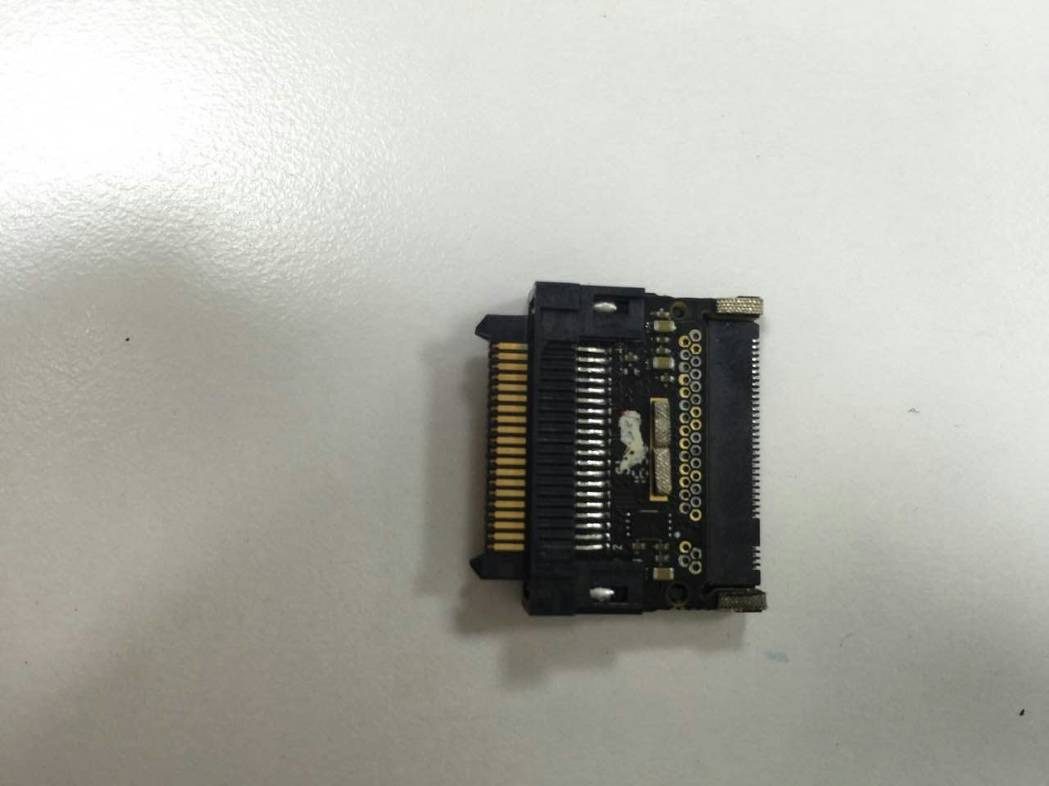
M.2 Interface and Proprietary Adapter Integration
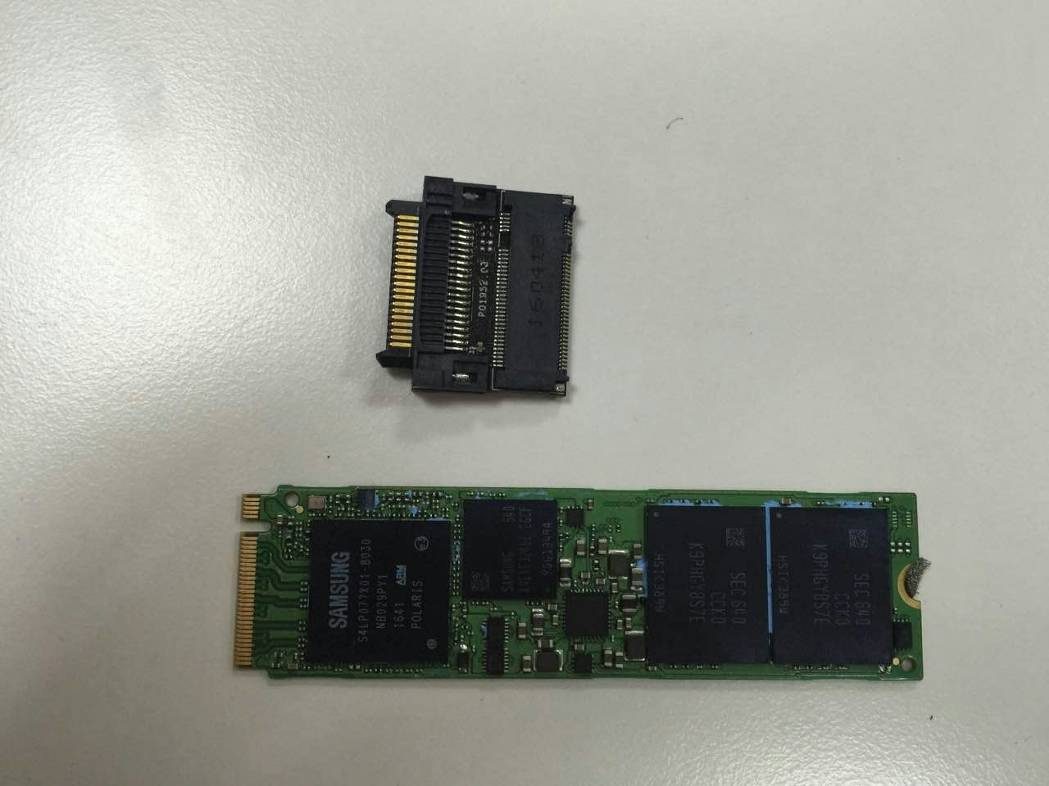
This image highlights the integration of a standard M.2 (NGFF) PCIe/NVMe edge connector, paired with a proprietary adapter tailored for DJI’s ecosystem. The board is densely populated near the controller and power management sections, with visible Samsung Polaris controller and multiple high-density NAND flash chips. The differential pair routing from the controller to the edge connector is optimized for high-speed data transfer, ensuring reliable communication with the host. The presence of a proprietary adapter suggests DJI’s intent to provide secure, high-bandwidth connections while maintaining compatibility with their unique hardware requirements. The overall assembly is compact and modular, designed for seamless integration and easy replacement in professional-grade drones or cameras.
High-Density Connector and Signal Integrity Focus
A close inspection of the PCB’s connector region reveals a high-density edge connector, engineered for high-speed, high-reliability data transfer. Surrounding the connector are multiple test points and passive components, likely serving as signal conditioning and ESD protection. The use of fine-pitch traces and a dense via structure suggests careful impedance control, necessary for differential signal integrity in PCIe/NVMe applications. While no major ICs are present on this side, the board’s construction and connector alignment reflect DJI’s attention to modularity and robust system integration. The design supports the rigorous demands of professional video capture, ensuring secure physical and electrical connections within DJI’s proprietary systems.
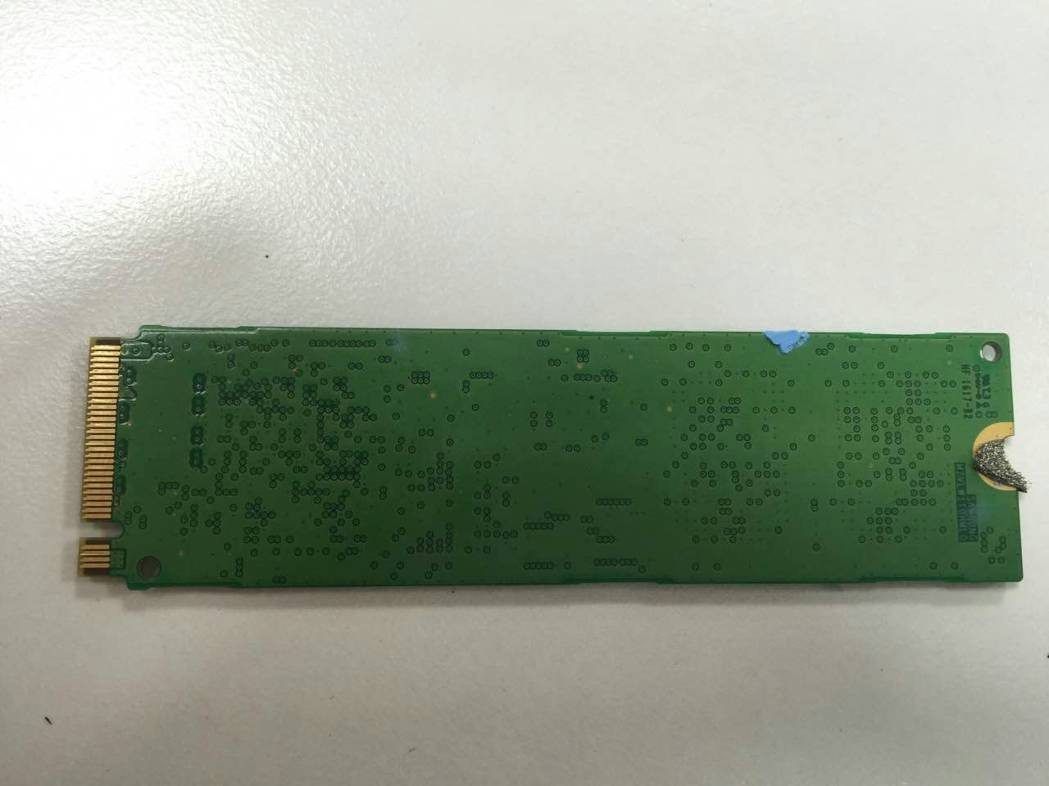
PCB Underside: Multi-Layer Design for High-Speed SSDs
The underside of the DJI CINESSD PCB is characterized by a dense array of vias and solder pads, indicative of a multi-layer FR4 construction. This side is devoid of active components, focusing instead on signal routing and power distribution. The gold-plated M.2 edge connector is prominently featured, enabling PCIe/NVMe communication with the host device. The meticulous via placement and clean solder mask finish demonstrate high manufacturing standards, essential for maintaining signal integrity and reliable operation at high data rates. This layer supports the overall structural and electrical performance of the SSD, contributing to its professional-grade reliability.
Regulatory Insights & FCC Filing
The FCC ID SS3-PS522M21611 certifies the DJI CINESSD’s compliance with US regulations on electromagnetic interference and RF emissions. This ensures the device is legal for sale and operation in the United States, affirming it poses no undue risk of interference with other electronic equipment. Although the grant date is listed as “None,” the registration on FCC.gov marks the product as authorized and market-ready.
FCC filings for such devices typically include comprehensive documentation: test reports covering electromagnetic compatibility (EMC) and RF exposure, internal and external photographs, user manuals, schematics, and block diagrams. These materials enable regulatory authorities and technical analysts to verify device safety and performance against federal standards.
According to the User Manual (User-Manual-3241109.pdf), the DJI CINESSD is essential for lossless video recording, specifically designed for the DJI Inspire 2 and similar equipment. The manual details operational guidelines, safety warnings, and environmental specifications, reflecting the device’s focus on reliability in diverse field conditions. The FCC filing process further mandates rigorous testing for emissions and immunity, which the DJI CINESSD passes as evidenced by its active FCC ID. This regulatory compliance is a testament to the device’s engineering quality and attention to electromagnetic compatibility.
Potential Use Cases & Target Audience
The DJI CINESSD, by virtue of its high-performance, robust construction, and seamless integration with DJI’s professional equipment, is ideally suited for several demanding scenarios:
- Professional Aerial Cinematography: Filmmakers using the DJI Inspire 2 can capture extended, lossless 4K/5K footage, relying on the CINESSD’s high data rates and reliability for uninterrupted shooting sessions. The large capacity and rapid transfer speeds are indispensable for high-end productions where data integrity is paramount.
- Studio and Field Video Production: Production crews needing portable, swappable storage for high-bitrate video benefit from the CINESSD’s rugged design and environmental tolerance. Its compatibility with a range of DJI equipment makes it a versatile choice for both on-location and studio work.
- Data-Intensive Research or Surveying: Users in mapping, inspection, or scientific research who require accurate, uncompressed video or imaging data can trust the CINESSD to handle large datasets efficiently, even in challenging environmental conditions.
While the target audience is not explicitly specified in the FCC filing, the device’s capabilities clearly address the needs of professional videographers, drone operators, and technical users demanding uncompromising storage performance.
Conclusion
The DJI CINESSD by SZ DJI TECHNOLOGY CO., LTD. (Model: CINESSD, FCC ID SS3-PS522M21611) stands out as a high-performance, professional-grade storage solution tailored for lossless video capture. Its robust engineering, advanced internal components, and compliance with US regulatory standards make it a trusted choice for demanding video and data applications. The meticulous design—evident from its multi-layer PCB, premium NAND flash, and effective thermal/EMI management—ensures reliable performance in the field. As professional content creation continues to evolve, the DJI CINESSD remains a critical enabler for capturing and preserving the highest quality footage, all while meeting the rigorous requirements of regulatory compliance and technical excellence.
