 Tech ID
Introduction
The DJI Spark, engineered by SZ DJI TECHNOLOGY CO., LTD., is a compact drone designed to bring advanced aerial photography and intelligent flight features to everyday users. Targeted at consumers seeking a small, easy-to-use flying camera, the Spark combines portability with a suite of smart features typically reserved for larger, more expensive drones. Its primary function is to capture stabilized, high-quality photos and video from the air, making complex shots accessible even to beginners.
One of the defining milestones for the DJI Spark is its FCC certification, identified by FCC ID SS3-MM1A1702. While the grant date is listed as ‘None’, the certification itself—registered via FCC.gov—confirms that the Spark meets stringent U.S. requirements for radio frequency (RF) emissions and electromagnetic compatibility. This legal compliance ensures the device can be sold and operated in the United States, providing consumers with confidence in its wireless safety and reliability.
This article offers a comprehensive breakdown of the DJI Spark’s key features, technical specifications, wireless technology, and a detailed teardown of its internal components, all anchored by insights from its FCC filing. Whether you’re an engineer, drone enthusiast, or a curious consumer, read on for an expert look at what sets the Spark apart in the crowded drone market.
Key Features & Specifications
The DJI Spark stands out as a feature-rich, ultra-portable drone tailored for both novice and experienced users. Below are its standout features and technical specifications, distilled from official manuals and regulatory filings:
Key Features
- Obstacle Avoidance: Utilizes advanced sensors to detect and avoid obstacles in real time, reducing the risk of collisions during flight.
- Infrared Sensing System: Enhances spatial awareness, enabling safer indoor and low-light flights through precise distance measurement.
- DJI GO 4 App Compatibility: Supports both Android (4.4+) and iOS (9.0+) devices, allowing for intuitive control, live video streaming, and intelligent flight mode access.
- Intelligent Flight Modes:
- ActiveTrack: Automatically follows subjects for dynamic, hands-free video capture.
- TapFly: Flies to a designated point with a simple tap on the screen, making complex maneuvers effortless.
- 2-Axis Gimbal Stabilization: Provides electronic and mechanical stabilization on pitch and roll axes, ensuring smooth, shake-free video and sharp photos.
- Intelligent Flight Battery: Features smart charge/discharge management, prolonging battery life and enhancing safety.
- Maximum Flight Time: Up to 16.5 minutes (ideal conditions), with real-world averages around 13 minutes per charge.
- Maximum Flight Speed: Reaches speeds of up to 29 mph (46.8 kph), enabling fast-paced aerial shots and agile maneuvers.
Technical Specifications
- Camera:
- Photo Format: JPEG
- Maximum Image Size: 4000 x 2944 pixels
- Video: MP4 (MPEG-4 AVC/H.264), FHD 1920×1080p30
- Sensor: 1/2.3” CMOS, 12 Megapixels effective
- Lens: 83.6° FOV, 25.2 mm (35 mm format equivalent), f/2.8, focus from 1 m to ∞
- Battery:
- Capacity: 1480 mAh, 16.87 Wh, LiPo 3S
- Net Weight: ~95 g
- Voltage: 11.4 V, Max Charging Voltage: 13.05 V
- Max Hovering Time: 15 minutes (no wind)
- Avg. Flight Time: 13 minutes (general flight, 15% remaining)
- Operating Temperature: 41° to 104° F (5° to 40° C)
- Flight Systems:
- Satellite Positioning: GPS/GLONASS
- Downward Vision System Altitude Range: 0 – 33 ft (0 – 10 m)
- Gimbal Controllable Range: Pitch: -85° to 0°
- Storage:
- Supported File Systems: FAT32 (≤ 32 GB), exFAT (> 32 GB)
- Wireless Connectivity:
- Wi-Fi: Supports 2.4 GHz (2412‐2462 MHz) and 5.8 GHz (5745‐5825 MHz) bands for robust, low-latency control and video transmission.
- Bluetooth: Present (specifics not detailed in manual), likely used for quick pairing and basic connectivity.
- Build Quality:
- Compact and lightweight, with high-density PCB design for optimal performance in a small footprint.
Benefits in Practice:
These features combine to make the DJI Spark exceptionally user-friendly. Intelligent flight modes and obstacle avoidance lower the barrier for capturing cinematic aerial footage, while the stabilized camera and robust wireless connection ensure high-quality media and responsive control. Its lightweight battery and efficient power management maximize flight duration, making it suitable for both quick shots and more deliberate, creative sessions.
Operating Frequencies
The DJI Spark (FCC ID SS3-MM1A1702) operates across the following RF bands, as detailed in its FCC filing:
| Frequency Range (GHz) | Output Power (mW) | FCC Rule Part |
|---|---|---|
| 2.412–2.462 | 282 | 15C |
| 5.745–5.825 | 193 | 15E |
These frequency allocations correspond to the 2.4 GHz and 5.8 GHz Wi-Fi bands, supporting reliable control and real-time video transmission. The specified output power levels are carefully regulated to ensure compliance with FCC Part 15 rules, balancing effective range with minimal interference to other devices. The use of dual-band Wi-Fi enhances performance in crowded environments and provides flexibility for optimal connectivity.
Technology Deep Dive
The DJI Spark leverages advanced wireless technologies to deliver a seamless user experience. The primary communication method is Wi-Fi, utilizing both 2.4 GHz and 5.8 GHz bands. This dual-band approach enables the Spark to maintain strong, interference-resistant connections in a variety of environments—urban, suburban, or rural.
Bluetooth functionality is also present, likely facilitating quick device pairing and initial setup, though it is not the main channel for flight control or video streaming. The absence of cellular connectivity reflects the Spark’s design as a consumer drone, where real-time, short-range wireless links are preferable for low latency and high bandwidth.
Operating within the specified frequency bands, the Spark balances output power for both range and battery efficiency. The 2.4 GHz band offers robust penetration and longer range, while the 5.8 GHz band provides cleaner channels in areas crowded with Wi-Fi networks. This flexibility enhances both control reliability and video quality during flight.
The inclusion of GPS/GLONASS modules allows for precise positioning and intelligent flight features, such as automated return-to-home and subject tracking. The regulatory-compliant RF emissions ensure the Spark operates safely alongside other wireless devices, minimizing the risk of interference.
In-Depth Internal Component Analysis / Teardown
Main PCB Section with Power and Signal Interfaces
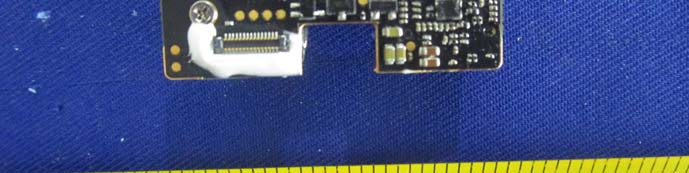
A close examination of one internal section reveals a high-density PCB populated with numerous surface-mount components, primarily capacitors, resistors, and possibly small power management ICs. The compact layout, fine-pitch components, and multiple vias suggest a multilayer board designed for efficient signal integrity and robust power distribution—essential for a drone’s demanding real-time operations. The visible FPC/FFC connector is likely dedicated to interfacing with a camera module or sensor, with the surrounding adhesive enhancing vibration resistance for in-flight stability. Several test points and a mounting screw highlight the emphasis on both mechanical robustness and ease of manufacturing or debugging. Notably, there are no major ICs or antenna structures in this section, indicating its role as a supporting interface rather than the core processing or RF area. The build quality is clearly high, with careful attention to modularity and component density.
Main PCB Assembly with Shielded SoC/RF Module
With the top cover removed, the core of the DJI Spark is revealed: a densely populated main PCB featuring a prominent shielded module bearing the DJI logo. This central module likely houses the primary system-on-chip (SoC) or RF subsystem, responsible for flight control, wireless communications, and video processing. The presence of differential pair routing nearby indicates high-speed data handling, vital for camera and RF interfaces. Robust EMI/RFI management is evident through extensive ground pours, stitching vias, and the use of a large metal shield can. Multiple FPC/FFC connectors and board-to-board interfaces facilitate modular assembly and connection to peripherals like the gimbal, sensors, and power distribution boards. Large inductors and capacitors point to sophisticated power regulation, necessary for managing the current demands of both motors and processing units. The inclusion of a substantial heatsink underscores the need for effective thermal management in such a compact, high-performance design. Overall, the assembly is a testament to advanced engineering, balancing miniaturization, modularity, and electromagnetic compatibility.

GPS/RF Module with Ceramic Patch Antenna
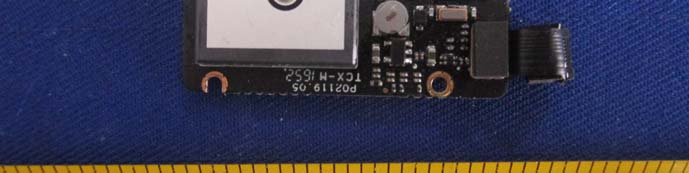
Another internal view exposes a specialized PCB module featuring a shielded component marked ‘P02119.05 TCX-H 1652,’ indicative of a GPS or RF receiver. The central element is a ceramic patch antenna, directly soldered to the PCB—a proven choice for accurate satellite positioning in compact devices. The shielded enclosure, reinforced by surrounding ground vias, provides robust EMI/RFI protection, ensuring clean signal reception even amidst the drone’s other wireless transmissions. The presence of a crystal oscillator supports the precise timing required for GPS operation, while a small FPC/FFC connector enables modular interfacing with the main controller. Test points facilitate manufacturing quality checks and troubleshooting. The overall design demonstrates careful attention to EMI control, modularity, and signal integrity, reflecting the Spark’s reliance on reliable, high-precision positioning for its intelligent flight modes.
Regulatory Insights & FCC Filing
Possessing FCC ID SS3-MM1A1702, the DJI Spark is certified as compliant with U.S. regulations governing electromagnetic emissions and RF exposure. This compliance is a prerequisite for legal sale and operation within the United States, ensuring the Spark does not interfere with other wireless devices and operates safely within prescribed limits.
While the grant date is listed as ‘None’, registration with the FCC signifies that the Spark has undergone rigorous testing and documentation. Typical FCC filings include laboratory test reports (RF exposure, electromagnetic compatibility), internal and external photographs, user manuals, schematics, and block diagrams. These documents provide transparency into the device’s construction and operational safety.
Insights from the user manual (Users-Manual-3402148.pdf) confirm that the Spark is engineered for simplicity and safety. Features such as a stabilized camera, intelligent flight modes, and obstacle avoidance are highlighted, reinforcing its appeal to both new and seasoned drone users. The Spark’s compliance with FCC standards assures users of its wireless reliability and minimal risk of interference, critical for a device that relies on real-time RF communication for both control and video transmission.
Potential Use Cases & Target Audience
The DJI Spark’s blend of advanced features and approachable design makes it ideal for a range of users and scenarios:
- Casual Content Creators: Individuals looking to capture high-quality aerial photos and videos for social media, travel vlogs, or personal projects. The Spark’s intelligent flight modes and stabilized camera make cinematic shots accessible to beginners.
- Outdoor Enthusiasts: Hikers, cyclists, or adventurers can use the Spark to document their activities from unique perspectives. Its compact size and lightweight construction make it easy to carry and deploy in the field.
- Tech-Savvy Families: Parents and teens seeking a fun, easy-to-use drone for recreational flying and creative expression will appreciate the Spark’s safety features, obstacle avoidance, and app-based controls.
In all these scenarios, the Spark’s 16.5-minute maximum flight time, robust wireless connection, and automated flight features unlock creative possibilities while keeping operation straightforward and safe.
Conclusion
The DJI Spark by SZ DJI TECHNOLOGY CO., LTD. (Model: Spark, FCC ID SS3-MM1A1702) exemplifies the convergence of compact design, advanced wireless technology, and user-friendly features in the consumer drone market. Its FCC certification guarantees regulatory compliance and wireless reliability, while a sophisticated internal architecture supports intelligent flight modes, stabilized imaging, and robust connectivity. For consumers seeking a portable, capable aerial camera, the Spark remains a standout choice—delivering professional-grade features in a form factor accessible to all.
