 Tech ID
Introduction
The Manifold 2, developed by SZ DJI TECHNOLOGY CO., LTD., stands as a robust, second-generation embedded computing platform purpose-built for demanding edge applications such as robotics, UAVs, and AI-driven systems. Available in two primary variants—the Manifold 2-G and Manifold 2-C—this device delivers high-performance processing and flexible I/O, catering specifically to Onboard SDK developers seeking to build, deploy, and manage advanced autonomous solutions.
A pivotal milestone in the Manifold 2’s journey to market is its certification under FCC ID SS3-MF2G0A201808. This certification not only affirms the device’s compliance with stringent US radiofrequency emission and electromagnetic interference standards, but also authorizes its legal sale and operation in the United States. For developers and integrators, this assures both regulatory peace of mind and optimal wireless performance.
In this article, we’ll provide an expert-level teardown of the Manifold 2, exploring its core specifications, wireless technologies, internal hardware, and the regulatory insights gleaned from its FCC filings. Whether you’re an embedded systems engineer, UAV developer, or tech enthusiast, this comprehensive analysis will clarify what sets the Manifold 2 apart as a next-generation edge computing platform.
Key Features & Specifications
The Manifold 2 is engineered to offer a balance of raw computing power, versatile connectivity, and robust reliability for mission-critical applications. Here’s a structured breakdown of its key features and technical specifications:
Key Features
-
Dual USB 3.0 Ports & USB 3.0 OTG:
Two standard USB 3.0 ports plus a USB 3.0 OTG port enable high-speed data transfers and flexible device interfacing, ideal for rapid sensor integration and external device connectivity. -
High-Performance Processing:
- Manifold 2-C: Equipped with an Intel Core i7-8550U processor, providing exceptional multi-core computational power for AI workloads, real-time analytics, and responsive control.
-
Manifold 2-G: Utilizes an NVIDIA Jetson TX2 module, offering hardware-accelerated graphics and efficient parallel processing for vision and deep learning tasks.
-
Advanced USB 3.0 Hub & XT30 Power Port:
A four-port USB 3.0 hub and XT30 power connector facilitate simultaneous high-speed peripheral access and reliable power supply, supporting complex embedded setups. -
Robust Storage Options:
- eMMC Storage: 32 GB onboard (G version, approx. 28 GB available).
-
SATA-SSD: 128 GB (G), 256 GB (C), with modular M.2 interface for easy expansion or replacement.
-
Rugged Operating Temperature:
Designed for harsh environments, the Manifold 2 operates reliably from -13° to 113° F (-25° to 45° C), making it suitable for outdoor and industrial deployments. -
Flexible Power Management:
- Input Power: 13.2 – 27.0 V via dual power ports.
- Independent power supply design.
- Max peak current: 30A (Low/High Power Output Port), 60A (High Power Input Port).
-
Power Distribution Unit supports 4S-6S LiPo batteries, ensuring uninterrupted power for compute-intensive missions.
-
Comprehensive Connectivity:
- Gigabit Ethernet (RJ-45): High-speed wired networking for low-latency data exchange and remote management.
-
UART Port: Serial communication for debugging, telemetry, or peripheral integration.
-
Wireless Capabilities:
- Wi-Fi: Supports IEEE 802.11a/b/g/n/ac standards, covering 2.4 GHz and multiple 5 GHz bands for fast, reliable wireless networking.
- Bluetooth: Present for short-range wireless device communication (detailed specs not provided).
Technical Specifications
- Processor Options:
- Manifold 2-G: NVIDIA Jetson TX2
-
Manifold 2-C: Intel Core i7-8550U
-
Storage:
- eMMC: 32 GB (G version)
-
SATA-SSD: 128 GB (G), 256 GB (C version)
-
Network:
- Gigabit Ethernet (RJ-45)
- Wi-Fi: IEEE 802.11a/b/g/n/ac
-
Bluetooth: Present
-
Power:
- Manifold 2-C: 5–60 W
- Manifold 2-G: 3–25 W
-
AC Adapter Rated Power: 57 W
-
Operating Temperature:
-
-13° to 113° F (-25° to 45° C)
-
I/O:
- USB 3.0 Ports × 2
- USB 3.0 OTG Port × 1
- UART Port × 1
-
Multiple FPC/FFC connectors for camera and expansion modules
-
Battery Integration:
- Max continuous current: 15A (Low Power Output), 30A (High Power Input)
- Power Distribution Unit: Supports 4S–6S LiPo batteries
These features collectively make the Manifold 2 a compelling choice for developers in need of a high-performance, extensible, and rugged edge computing solution—whether for autonomous drones, industrial robots, or smart infrastructure.
Operating Frequencies
The Manifold 2’s wireless capabilities are defined by its operation on several frequency bands, as documented in its FCC certification under ID SS3-MF2G0A201808. These frequencies determine its compatibility with various wireless standards and its ability to communicate effectively in diverse environments.
| Frequency Range (GHz) | Output Power (mW) | FCC Rule Part |
|---|---|---|
| 2.412–2.462 | 218.8 | 15CCC1.15.18 |
| 5.23 | 12.4 | 15ECC2.25.21 |
| 5.24 | 29.1 | 15ECC2.15.19 |
| 5.31 | 19.2 | 15ECC2.55.29 |
| 5.26–5.32 | 36.1 | 15ECC2.45.27 |
These frequency allocations are essential for understanding the device’s wireless reach, performance characteristics, and compliance with regulatory standards for Wi-Fi and Bluetooth operations.
Technology Deep Dive
The Manifold 2 leverages advanced wireless technologies, primarily focusing on Wi-Fi (IEEE 802.11a/b/g/n/ac) and Bluetooth. With multi-band Wi-Fi support spanning both 2.4 GHz and 5 GHz channels, the device ensures high-speed, low-latency connectivity critical for real-time data transfer, remote control, and cloud integration in UAV and robotics applications.
The inclusion of Bluetooth, while not detailed in the documentation, further broadens its wireless communication capabilities, facilitating peripheral connections and short-range device pairing. The absence of cellular connectivity aligns with its role as a local compute and control platform, emphasizing reliability and predictable network behavior.
Operating across several regulated frequency bands, the Manifold 2 achieves a balance of range, throughput, and resilience to interference. The 2.4 GHz band offers robust penetration and longer range—ideal for general connectivity—while the higher 5 GHz bands deliver superior bandwidth and reduced congestion, supporting high-throughput applications like HD video streaming or real-time sensor fusion. Power levels across these bands are carefully regulated, ensuring compliance with FCC standards and minimizing the risk of interference with other wireless systems.
From a system design perspective, these wireless features, validated in the test reports included in the FCC filing documents, guarantee the Manifold 2’s safe and effective operation in complex RF environments, underscoring its suitability for mission-critical edge applications.
In-Depth Internal Component Analysis / Teardown
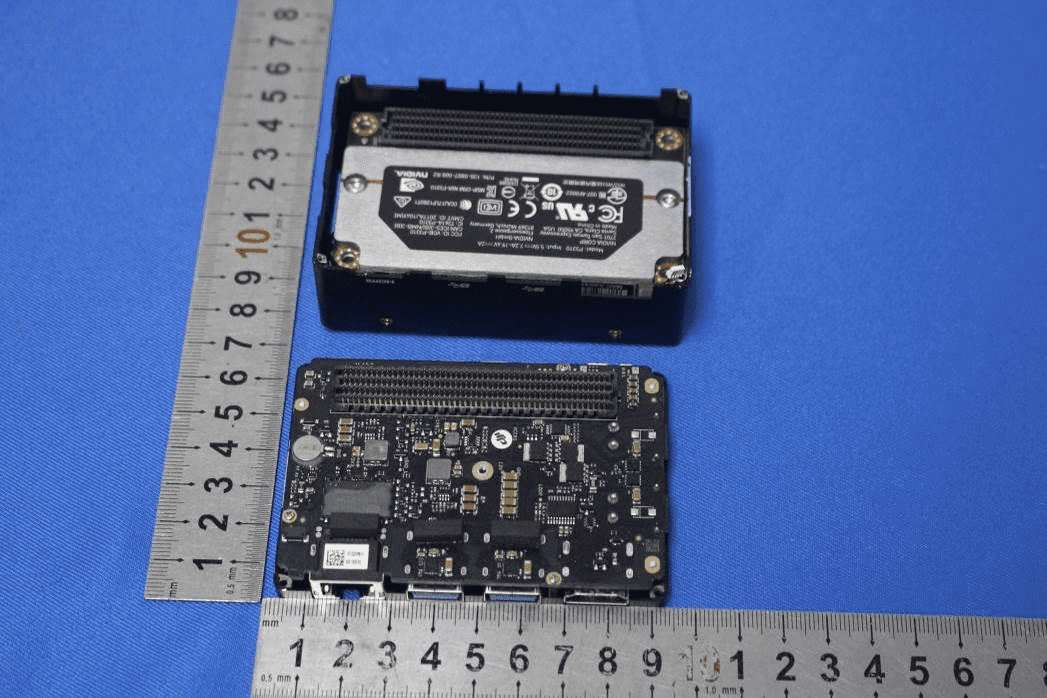
A comprehensive examination of the Manifold 2’s internal hardware reveals a meticulously engineered platform designed for reliability, modularity, and high performance. Drawing from detailed component photographs, here’s an expert breakdown of its key internal assemblies:
The main circuit board exhibits a dense population of surface-mount components, dominated by a large system-on-chip (SoC) or processor, indicative of the Manifold 2’s use of powerful NVIDIA or ARM-based modules. Multiple smaller ICs surround the main processor, likely serving as power management, memory, and interface controllers. The high-density board-to-board connector stands out, facilitating seamless modular integration with carrier or expansion boards. The PCB’s multi-layer construction, visible through extensive via stitching and controlled impedance traces, ensures robust high-speed data transfer and signal integrity. Notably, large inductors and capacitors are strategically placed for stable power delivery, while the absence of on-board antennas suggests reliance on external RF modules. The overall build quality reflects a production-grade embedded system, optimized for demanding edge computing in UAV and robotics environments.
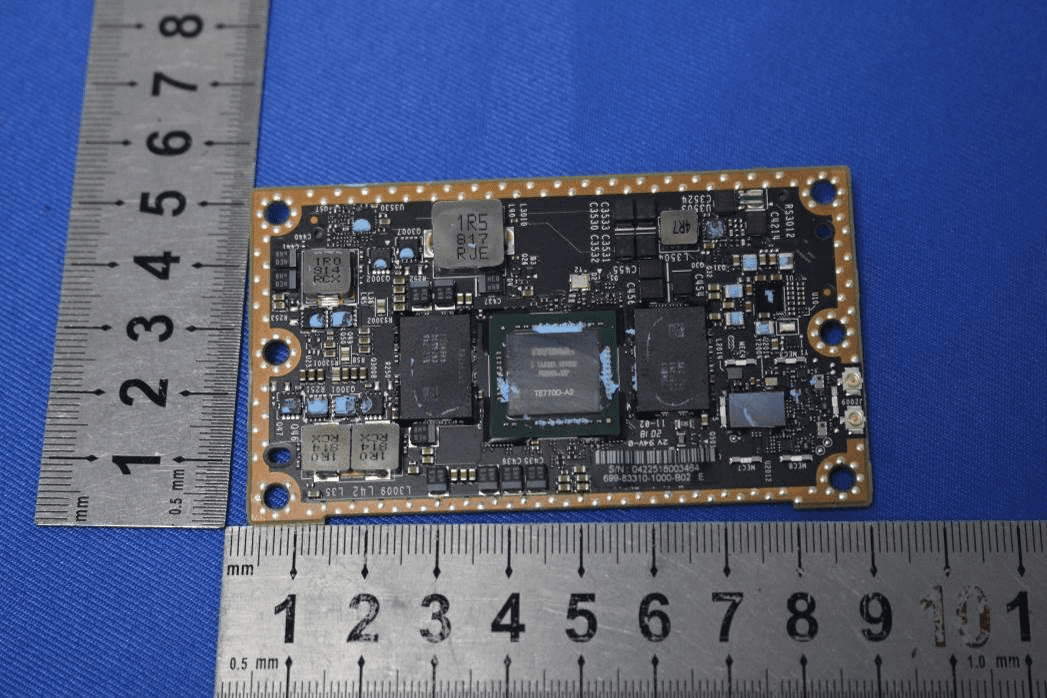
The compute module’s central area is dominated by a large BGA package, almost certainly the main SoC—likely an NVIDIA Tegra processor, aligning with the Manifold 2’s AI and vision processing pedigree. Flanking this are several large memory ICs, probably LPDDR4 and eMMC/NAND flash, providing the high-speed memory and storage necessary for AI workloads. The PCB’s black solder mask, multi-layer design, and meticulous via placement underscore a focus on signal integrity and EMI mitigation. Edge-mounted gold pads and sturdy mounting holes enable secure integration and efficient thermal management, while the absence of visible antennas or standard connectors suggests this is a modular compute core destined for stacking with I/O-rich carrier boards. The sophistication of the layout and power subsystem is consistent with the requirements of advanced robotics and autonomous platforms.
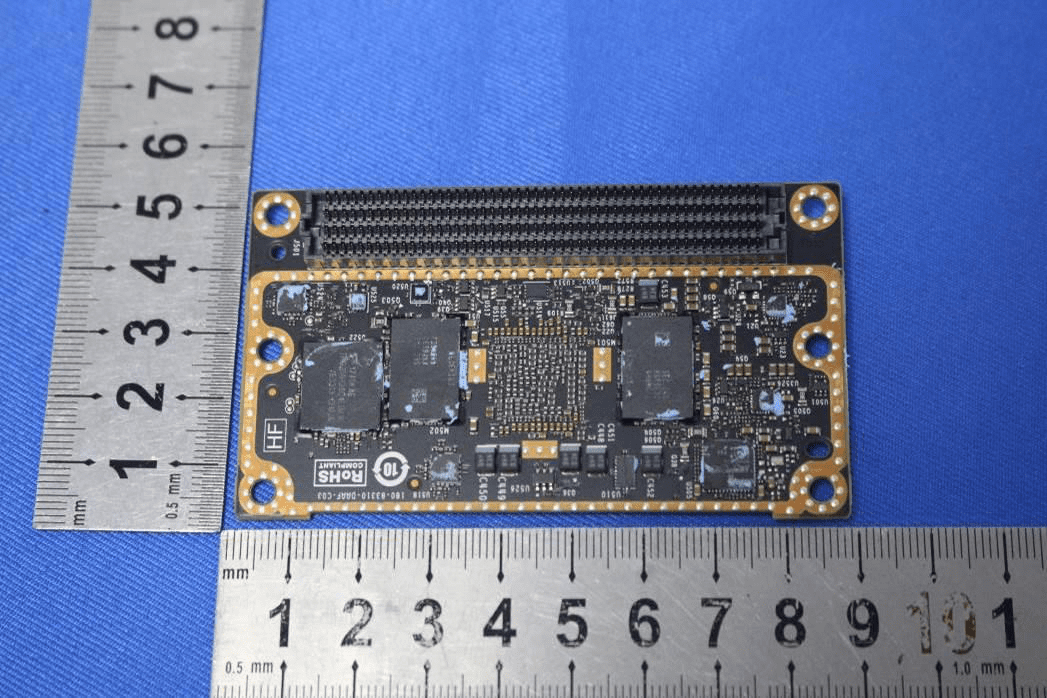
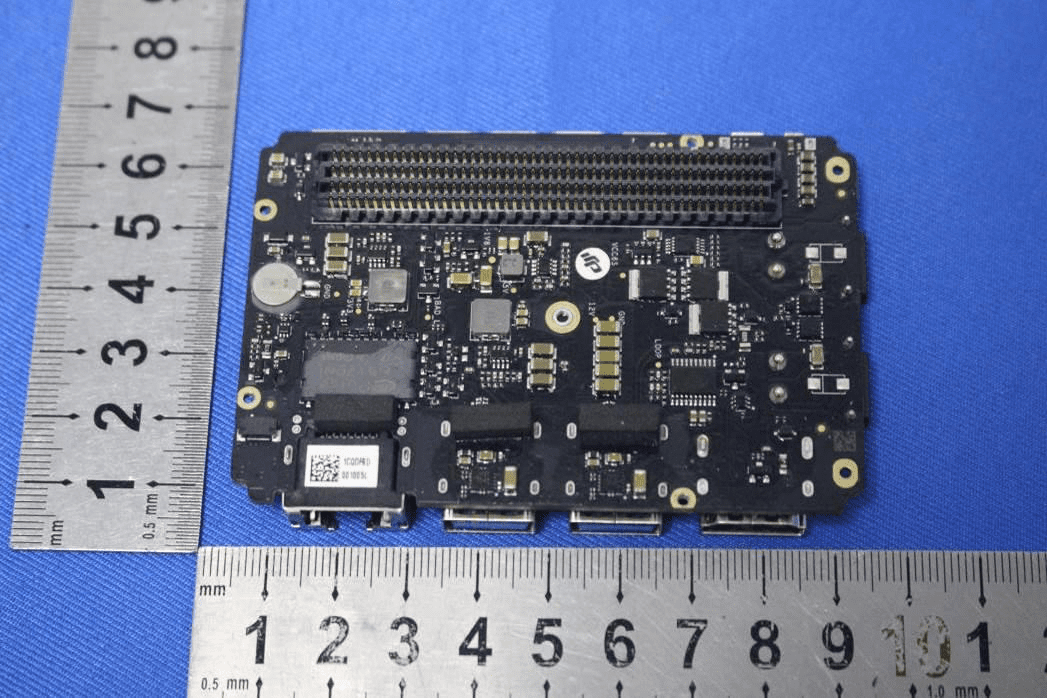
A compact, densely populated board reveals several large BGA and QFP ICs, likely comprising the main SoC and adjacent memory modules. The prominent high-density connector at the top facilitates modular stacking, ensuring scalability and easy integration into larger embedded systems. The black multi-layer PCB showcases extensive differential pair routing and grounding techniques, critical for high-speed data paths such as DDR, PCIe, or MIPI interfaces. Numerous small test points and connectors provide avenues for debugging and peripheral expansion. The overall layout is consistent with a high-performance edge computing module, balancing raw compute power with modular flexibility for diverse UAV and robotics use cases.
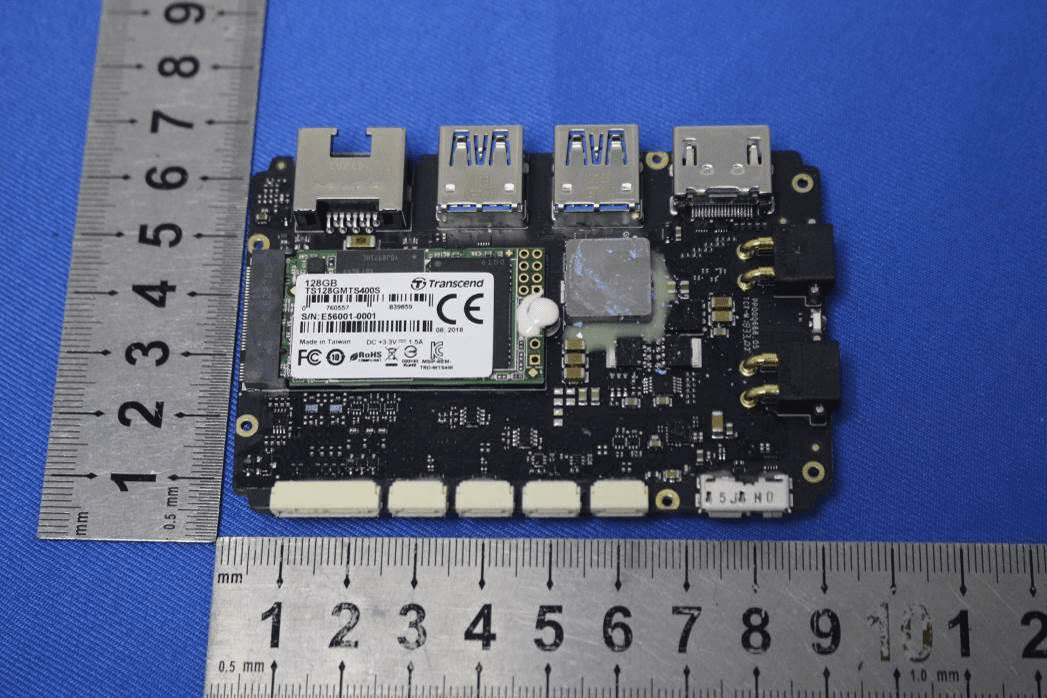
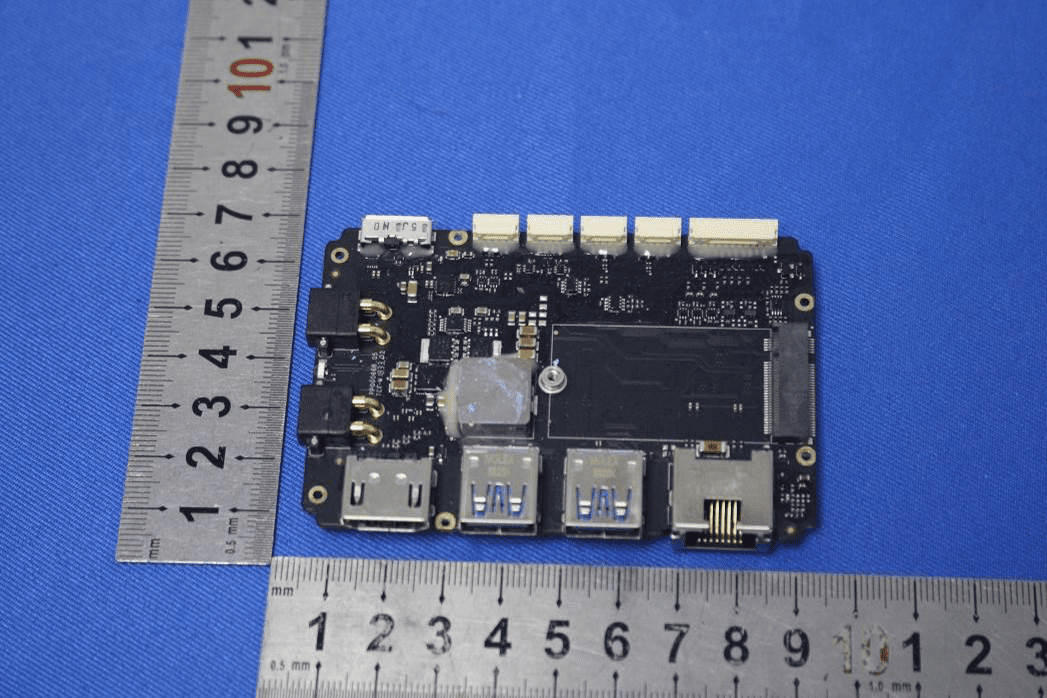
This assembly features a black PCB densely populated with components and connectors, including a removable Transcend 128GB M.2 SATA SSD—highlighting the platform’s flexibility in storage expansion. The main SoC, partially covered with thermal paste and a metallic heat spreader, sits at the heart of the board, ensuring both performance and thermal management. The presence of USB 3.0, HDMI, and Gigabit Ethernet connectors along the board’s edge demonstrates the Manifold 2’s commitment to versatile high-speed I/O. Multiple FPC/FFC connectors and robust power regulation circuits further support the device’s adaptability and reliability in complex embedded applications. The careful attention to signal integrity, EMI control, and thermal dissipation is evident throughout the design.
A high-density PCB is revealed, with a large BGA processor likely hidden beneath a black thermal pad. Surrounding components include a mix of memory, power management, and interface ICs, as indicated by the variety of QFN and BGA packages. The board’s black solder mask, dense microvia population, and differential pair routing point to a multi-layer, high-speed design. A prominent high-density board-to-board connector at the top, paired with multiple FPC/FFC connectors, underscores the modular nature of the Manifold 2 platform. The layout is optimized for signal integrity, power delivery, and expansion, supporting the compute and I/O demands of edge AI and robotics.
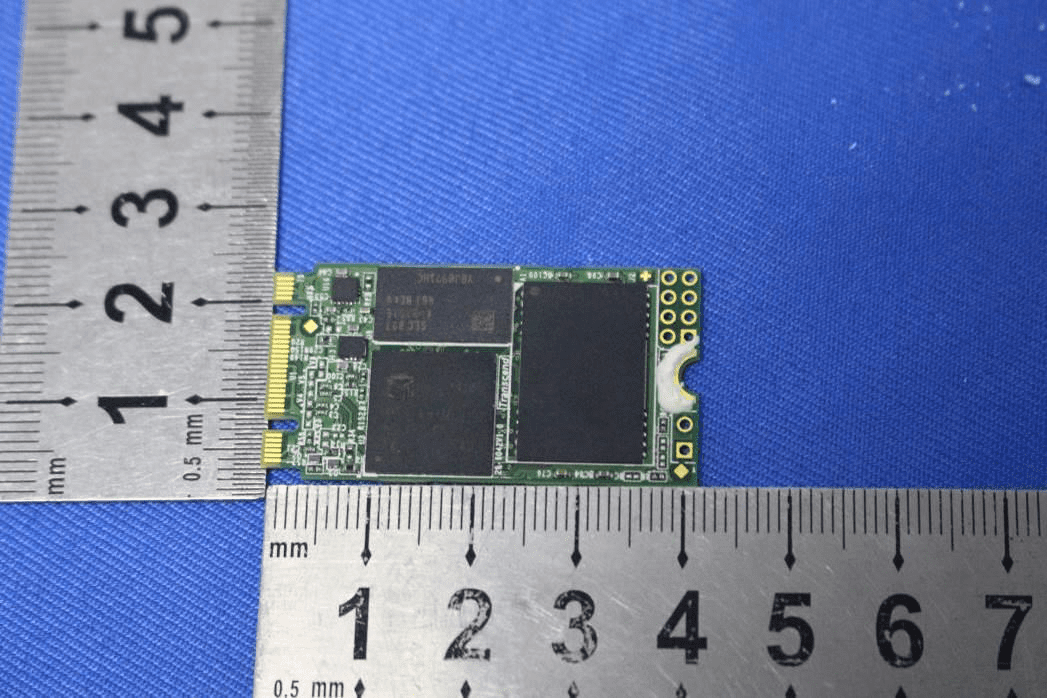
A compact module, likely in M.2 or mini-PCIe form factor, is populated with two major ICs—one marked as potential NAND flash or DRAM, and another possibly a controller. The gold-fingered edge connector and dense component layout suggest this is a storage or memory module, designed for high-speed data transfer and easy modular replacement. Ground via stitching and fine-pitch traces indicate a focus on signal integrity and reliability. The engineering choices reflect the Manifold 2’s emphasis on modularity and serviceability, ensuring developers can upgrade or maintain storage with minimal downtime.
Another densely populated black PCB features a large metal shield covering the main processor area, providing both EMI protection and thermal management. Visible connectors include dual USB 3.0 ports, HDMI, RJ45 Ethernet, and multiple FPC/FFC connectors—highlighting the board’s extensive I/O capabilities. Robust power regulation is evident from the presence of several inductors and capacitors, while multiple test points and a small switch (likely reset or power) support development and debugging. The board’s modularity, high-speed connectors, and shielding showcase its suitability for embedded AI, vision, and control applications, reinforcing the high engineering standards of the Manifold 2 series.
Regulatory Insights & FCC Filing
The Manifold 2’s FCC certification—documented under FCC ID SS3-MF2G0A201808—serves as a testament to its compliance with stringent US electromagnetic interference and RF emission standards. This certification is a legal prerequisite for commercial sale and operation within the United States, ensuring that the device will not cause harmful interference to other electronic equipment or communication systems.
The FCC filing process involves rigorous laboratory testing and documentation, including detailed test reports on RF exposure, electromagnetic compatibility (EMC), and spurious emissions. Supporting materials typically encompass internal and external photographs, user manuals, schematics, and block diagrams, all of which provide transparency into the device’s design and operation.
From the available documentation, several key insights emerge:
– The Manifold 2 is explicitly targeted at Onboard SDK developers, offering both NVIDIA Jetson TX2 (Manifold 2-G) and Intel Core i7-8550U (Manifold 2-C) configurations.
– Its wireless modules are thoroughly tested for compliance across all supported Wi-Fi and Bluetooth bands, ensuring reliable operation in both 2.4 GHz and 5 GHz environments.
– The device’s modular design, robust power management, and thermal engineering are validated through internal documentation and component analysis, underscoring its suitability for high-performance, mission-critical applications.
Ultimately, the FCC ID SS3-MF2G0A201808 designation not only confirms regulatory compliance but also reinforces the Manifold 2’s positioning as a trustworthy, production-grade platform for advanced edge computing.
Potential Use Cases & Target Audience
The Manifold 2’s unique blend of high-performance processing, modular I/O, and robust wireless connectivity positions it as an ideal platform for several demanding scenarios:
-
Autonomous UAV Development:
Onboard SDK developers can leverage the Manifold 2-G’s NVIDIA Jetson TX2 module for real-time object detection, flight control, and sensor fusion, enabling sophisticated autonomous drone missions. Its seamless compatibility with DJI flight platforms and flexible power integration streamline deployment in aerial robotics. -
Industrial Robotics & Vision Systems:
The Manifold 2-C’s Intel Core i7-8550U processor provides the computational muscle for advanced machine vision, path planning, and real-time analytics in industrial automation. Developers benefit from its extensive peripheral support, enabling integration with cameras, LIDAR, and industrial sensors. -
Rapid Prototyping & Research:
Researchers and developers requiring a robust, extensible edge computing platform can utilize the Manifold 2’s modular architecture to rapidly prototype and deploy new algorithms, leveraging its rich I/O, wireless networking, and reliable power management for field or lab environments.
These use cases highlight the Manifold 2’s appeal to engineers, AI developers, and system integrators seeking a production-ready platform for next-generation autonomous systems.
Conclusion
The Manifold 2 by SZ DJI TECHNOLOGY CO., LTD. exemplifies the convergence of high-performance embedded computing and robust wireless communication in a modular, developer-friendly platform. Its FCC certification under ID SS3-MF2G0A201808 affirms both its regulatory compliance and engineering pedigree, making it a reliable choice for advanced UAV, robotics, and AI-driven applications. With its powerful processor options, versatile I/O, and meticulous internal design, the Manifold 2 sets a new benchmark for edge computing solutions in mission-critical environments. For developers and integrators demanding reliability, flexibility, and performance, the Manifold 2 stands out as a future-ready foundation.
