 Tech ID
Introduction
The Thumb Controller by SZ DJI TECHNOLOGY CO., LTD (Model: RONIN TC1) represents a leap forward in intuitive, handheld gimbal control for the DJI Ronin and Ronin-M series. Designed as a compact, pressure-sensitive remote, this accessory empowers filmmakers and content creators to manipulate pan, tilt, and roll axes with precision—directly from the grip of their gimbal setup. With its quick-release mount, OLED status display, and wireless communication capabilities, the Thumb Controller is engineered for both solo operators and professional crews seeking streamlined, on-the-fly adjustments.
Critically, the device has undergone rigorous assessment and achieved FCC certification under FCC ID SS3-800RX1512 (grant date: None), signifying its compliance with US radio frequency emission standards and legal status for sale and operation in the United States. This certification ensures the controller meets stringent requirements for RF emissions, interference, and safety—vital for mission-critical use in diverse filming environments.
In this article, we break down the Thumb Controller’s key features, technical specifications, wireless technologies, internal hardware, and regulatory standing. Whether you’re a Ronin user seeking a technical edge or an engineering enthusiast interested in teardown insights, this detailed guide will illuminate the technology and compliance behind this advanced controller.
Key Features & Specifications
The Thumb Controller by SZ DJI TECHNOLOGY CO., LTD is meticulously engineered for seamless integration with the Ronin and Ronin-M handheld gimbal systems. Below is a detailed breakdown of its standout features and technical attributes:
Key Features
- Controller Priority: When used alongside a remote controller, the Thumb Controller can take operational precedence, allowing for instant manual override and fine-tuned gimbal control.
- Sleep and Auto Power-Off: Integrated power management conserves battery life, automatically placing the device in sleep mode or powering off when inactive.
- Quick-Release Accessory Mount: Supports rapid attachment and detachment, enabling fast setup changes in the field.
- Wireless Communication: Utilizes an internal receiver to establish a robust, low-latency wireless link with the Ronin-M gimbal, freeing operators from cumbersome cabling.
- SmoothTrack Speed Adjustment: Offers three selectable profiles—Fast, Normal, Slow—enabling users to tailor the gimbal’s responsiveness to specific shooting styles or subject dynamics.
- Sensitivity Settings: Soft and Hard modes allow further customization of control input, optimizing for either subtle or assertive motion.
- Pressure-Sensitive Stick: The main control interface is a pressure-sensitive joystick, delivering nuanced, proportional control over gimbal movement for cinematic precision.
- Override Button: Dedicated for update recovery and system overrides, ensuring reliable operation even during firmware updates or troubleshooting.
Technical Specifications
- Operating Temperature: -20° to 50°C (suitable for demanding outdoor use)
- Working Current: <100mA @ 3.3V (energy-efficient design)
- Communication Distance: 60 meters (enables flexible remote operation on set)
- Operating Frequency: 2.415GHz–2.473GHz (within the 2.4GHz ISM band)
- Mounting Bracket Diameter: 1.0 in. or 1.2 in. (25mm or 30mm), compatible with standard Ronin grips
- Supported Devices: Ronin, Ronin-M
- Charge Time: 2 hours (fast recharge for minimal downtime)
- Battery Type: LiPo (Lithium Polymer, high energy density)
Additional Extracted Specs
- Bluetooth: Present (precise version not specified)
- Battery Capacity: 1150mAh
- Battery Voltage: 3.7V
- Standby Life: 20 hours
- Battery Life (Operational): 18 hours
Practical implications:
These features and specifications translate to a controller that is not only highly portable and ergonomic but also reliable for extended shoots. The combination of long battery life, robust wireless range, and customizable control profiles makes it ideal for both solo shooters and coordinated multi-operator setups.
Operating Frequencies
The Thumb Controller (FCC ID SS3-800RX1512) operates within the following RF parameters as documented in its FCC filings:
| Frequency Range (GHz) | Output Power (mW) | FCC Rule Part |
|---|---|---|
| 2.415–2.473 | 5 | 15C C1.1 |
Significance:
Operating within the 2.4GHz ISM band—shared by Wi-Fi, Bluetooth, and other low-power wireless devices—the controller’s modest output power (5mW) is optimized for interference avoidance and efficient battery usage. The specified frequency range ensures compatibility with common wireless protocols while meeting regulatory requirements for unlicensed spectrum use.
Technology Deep Dive
At its core, the Thumb Controller leverages advanced wireless technologies tailored for robust, low-latency communication with Ronin gimbals. The use of the 2.4GHz ISM band suggests the inclusion of protocols akin to Bluetooth or proprietary RF, providing a balance between range (up to 60 meters), power efficiency, and minimal susceptibility to interference in crowded environments.
The device’s internal architecture, as inferred from the FCC documentation and teardown, incorporates both a PCB trace antenna and an option for an external antenna. This dual-antenna approach enhances wireless performance, maintaining a stable connection even in RF-congested areas—a critical advantage during live production.
Power consumption is tightly managed, with the controller drawing less than 100mA at 3.3V, supporting up to 18 hours of continuous use. The pressure-sensitive stick and user interface are powered by a responsive microcontroller, while the onboard LiPo battery ensures reliable operation throughout demanding shoots.
Test reports (where available) indicate compliance with FCC Part 15C for intentional radiators, confirming the controller’s adherence to strict limits on spurious emissions and RF exposure. These engineering choices collectively deliver a responsive, interference-resilient wireless control experience tailored to professional cinematography.
In-Depth Internal Component Analysis / Teardown
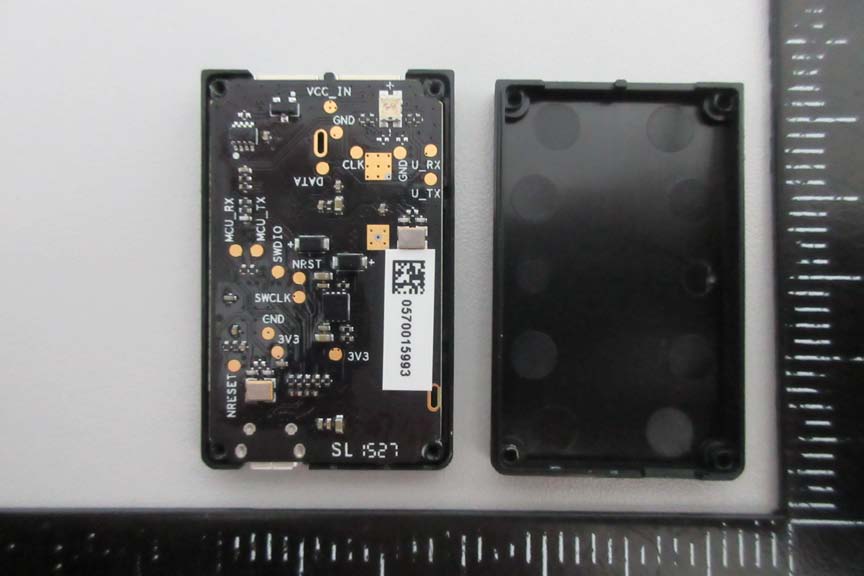
Main PCB with Microcontroller and Debug Interfaces
The internal architecture showcases a densely populated, high-quality black PCB, featuring a central microcontroller (MCU) surrounded by well-labeled test points for UART and SWD debugging. The component placement and silkscreen labeling (VCC_IN, GND, SWDIO, SWCLK, U_TX, U_RX) reflect a design optimized for both manufacturing and serviceability. Multiple small ICs, likely voltage regulators and interface chips, support the core logic. The board’s multi-layer construction, robust ground pours, and stitching vias ensure excellent signal integrity and EMI control. The absence of visible antennas or shields on this side indicates that RF components are either on the reverse or incorporated as PCB trace antennas elsewhere. Overall, the design exudes a modern, modular approach with a clear emphasis on reliability and ease of assembly.
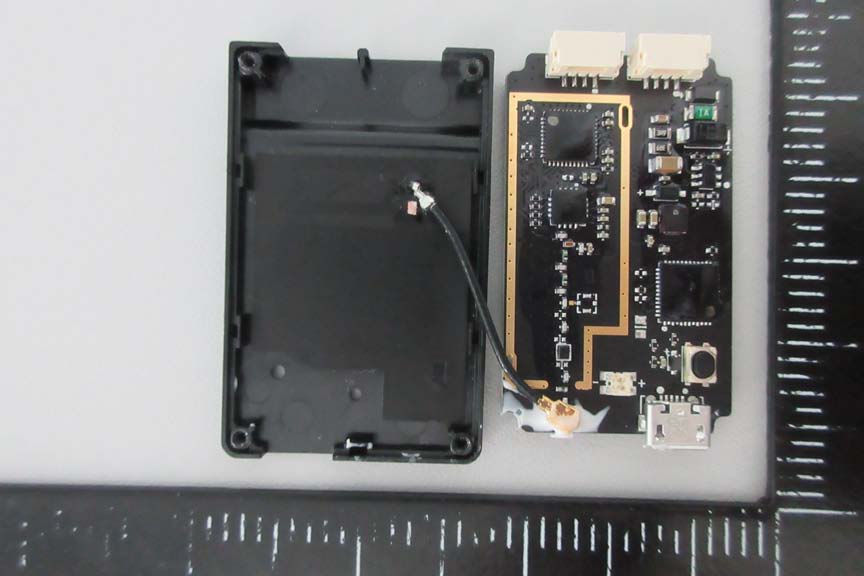
Wireless Communication PCB with Dual Antenna Options
This view reveals a highly integrated PCB removed from its enclosure, highlighting the controller’s wireless communication prowess. The board features a meandered PCB trace antenna optimized for the 2.4GHz band and a U.FL connector for an optional external antenna—underscoring a design focused on RF performance and flexibility. Key ICs, likely including the main MCU and RF front-end, are strategically placed for optimal signal routing. The presence of large FPC/FFC connectors and a micro-USB port demonstrates modularity and support for firmware updates or charging. EMI suppression is handled via ferrite beads and careful grounding, while the inclusion of tactile switches and status LEDs caters to user interaction and feedback. The gold-finished (ENIG) black PCB, controlled impedance routing, and attention to RF layout reveal an engineering focus on low-latency, reliable wireless control essential for gimbal operation.
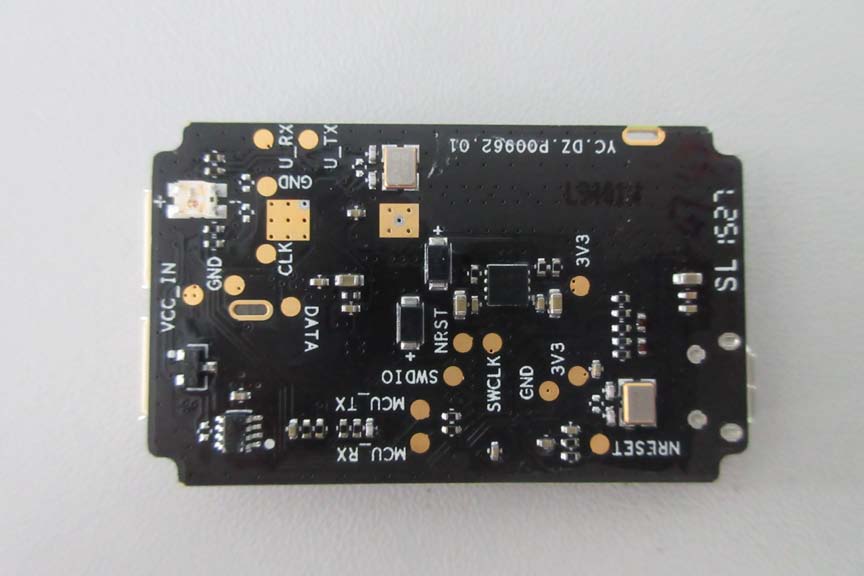
Control Module PCB with Debug and Power Interfaces
This compact black PCB exhibits a well-organized, multi-layer design with a mix of fine-pitch and larger components. The absence of a large SoC or RF transceiver on this side suggests its role as a control or interface module. Labeled edge connectors, test points, and silkscreened debug pads (SWDIO, SWCLK, NRST, MCU_TX/RX) point to a focus on programming, manufacturing, and system integration. Local voltage regulation is handled by discrete inductors and capacitors, while robust power conversion is inferred from the presence of VCC-IN and 3V3 rails. No antenna or explicit RF components are visible here, implying that wireless functions are managed on another board or PCB layer. The design prioritizes modularity, reliability, and ease of integration—key for a handheld accessory meant for professional environments.
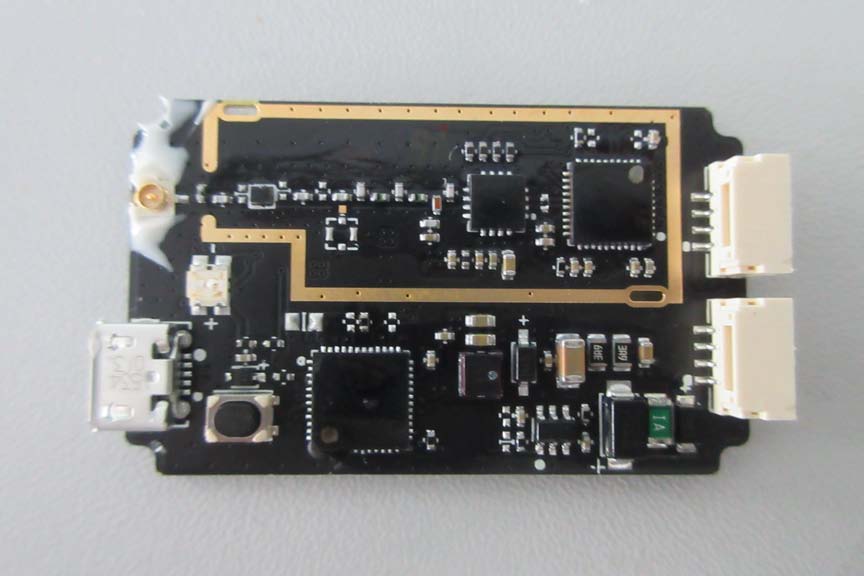
RF and Power Management Subsystem
The final internal image showcases a sophisticated assembly with multiple large QFP/QFN ICs—likely the main microcontroller and RF transceiver—supported by power management and memory chips. A gold PCB antenna (likely IFA design) occupies the upper left, complemented by a U.FL connector for external antenna support, ensuring adaptable wireless connectivity. The PCB’s multi-layer construction, with extensive ground stitching and separation of analog/RF and digital domains, highlights meticulous RF design. Power management is robust, featuring large capacitors, a prominent inductor, and a polyfuse for protection. A micro-USB port provides charging and data transfer, while tactile switches and status LEDs facilitate user interaction. The overall engineering reflects a commitment to reliability, power efficiency, and high-performance wireless operation—hallmarks of a premium, professional-grade controller.
Regulatory Insights & FCC Filing
The Thumb Controller’s FCC ID SS3-800RX1512 is more than a regulatory formality—it’s a guarantee of compliance with stringent US standards on electromagnetic interference and RF emissions. This certification, issued by the FCC (grant date: None), confirms the device meets all legal requirements for sale and use in the United States.
FCC filings for this device include exhaustive documentation:
– Test Reports: Validate adherence to RF exposure, spurious emissions, and electromagnetic compatibility (EMC) limits.
– Internal and External Photos: Provide transparency into the device’s build and layout for compliance verification.
– User Manual: Outlines operational modes, safety instructions, and technical specs.
– Schematics and Block Diagrams: Detail the electronic architecture for regulatory review.
From the summarized user manual (Users-Manual-2905418.pdf), the DJI Thumb Controller is positioned as a dedicated accessory for Ronin series handheld gimbals. Its pressure-sensitive stick and OLED display enable direct, intuitive control over pan, tilt, and roll axes, with customizable responsiveness. The manual also highlights safety, mounting, charging, and troubleshooting guidance—essential for both end users and regulatory authorities.
The FCC ID SS3-800RX1512 thus not only ensures legal market access but also attests to the controller’s engineering rigor and operational safety.
Potential Use Cases & Target Audience
The Thumb Controller is purpose-built for DJI Ronin series handheld gimbal users, offering distinct advantages across a range of real-world scenarios:
- Solo Cinematographers: For individual filmmakers or vloggers, the pressure-sensitive stick and OLED display provide intuitive, single-handed control over gimbal movement, enabling smooth, cinematic shots without the need for a second operator.
- Professional Film Crews: In multi-operator setups, a camera assistant can use the Thumb Controller to make rapid pan, tilt, or roll adjustments on the fly, while the primary operator focuses on movement—maximizing creative flexibility during dynamic shoots.
- Live Event Coverage: Event videographers can exploit the controller’s wireless range and long battery life to adjust gimbal orientation discreetly from a distance, capturing spontaneous moments with precision and minimal interruption.
In all cases, the Thumb Controller’s ergonomic design, robust wireless link, and customizable control profiles deliver a tangible edge for demanding users seeking both reliability and creative freedom.
Conclusion
The Thumb Controller by SZ DJI TECHNOLOGY CO., LTD (Model: RONIN TC1), certified under FCC ID SS3-800RX1512, stands out as a thoughtfully engineered, professional-grade accessory for Ronin gimbal operators. Its blend of robust wireless communication, pressure-sensitive control, and modular design is matched by a commitment to regulatory compliance and operational safety. Whether in the hands of a solo creator or a professional crew, this controller delivers precise, intuitive gimbal management—empowering users to push the boundaries of handheld cinematography with confidence.
